News list
Why Do Road Markings Peel Off? Common Factors from Pavement Condition to Material Application
News list
Why Do Road Markings Peel Off? Common Factors from Pavement Condition to Material Application
Why Do Road Markings Peel Off? Common Factors from Pavement Condition to Material Application
Release time:2026-09-01
Share:


After road markings have been in service for some time, localized cracking, wear, or peeling may appear. When this happens, it is easy to attribute the problem immediately to the marking material. In practice, however, a road marking is the result of applying a material to a real pavement under actual construction conditions.
The marking material needs to interact with the pavement surface, and road surfaces are not identical construction substrates. Pavement structure, age, dust, moisture, contaminants, and onsite conditions may vary between projects.
For this reason, investigating marking deterioration requires looking beyond the material itself and considering how it was applied to the road.
Regardless of the road marking material selected, application ultimately takes place on the pavement. If dust, soil, or other contaminants remain within the work area, the marking material may interact with the contamination rather than directly with a properly prepared pavement surface.
This is why pavement inspection and cleaning are normally important preparation stages. Existing roads may also require inspection of old markings, pavement wear, and other surface conditions.
Surface preparation does not change the technical specifications of the paint itself, but it changes the surface on which the material is applied. Pavement condition therefore deserves attention when examining marking adhesion.
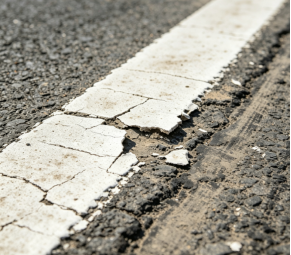
Road marking materials are available in different systems. Depending on project requirements, contractors may use thermoplastic marking paint, solvent-based marking paint, water-based marking paint, or two-component marking paint.
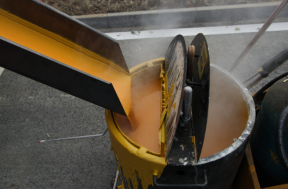
Thermoplastic material, for example, needs to be heated to an appropriate application condition before being applied. Other material systems also have their corresponding application processes. Once the material is selected, equipment, material preparation, and onsite operation need to work together.

TATU Coatings provides thermoplastic, solvent-based, water-based, and two-component road marking materials. Selecting a suitable material is therefore only one part of the process; applying it according to the corresponding material system is equally important.
Road marking takes place in an outdoor environment, where conditions are not as stable as those inside a controlled production facility. Temperature, pavement condition, and weather can create different requirements for onsite construction.
Road marking projects therefore cannot always be carried out according to one fixed template. Even when similar materials are used, contractors still need to consider local conditions, season, pavement status, and application requirements.
The marking material, application equipment, and onsite environment need to function as part of the same construction process.
Once applied, a road marking does not remain untouched. Vehicle tires repeatedly pass over the marking surface, while turning, braking, and lane-changing areas may experience more complex wear.
Actual traffic conditions should therefore also be considered when evaluating marking condition. A high-traffic road and a low-traffic area may show different long-term results even when similar materials are used.
Material selection, pavement preparation, application, and subsequent traffic exposure together form the lifecycle of a road marking. Understanding how these factors interact provides a more complete way to investigate marking deterioration.
Related Reading

Why do road markings appear brighter at night? How do glass beads and road marking paint work together?
2026-08-28
Why Does Thermoplastic Road Marking Require Heating? Understanding the Application Logic of Thermoplastic Markings Through Material Conditions
2026-08-26
Don’t Be Fooled by Cheap Road Marking Coatings: Beware of Hidden Maintenance Costs
2026-08-06