News list
Why do road markings appear brighter at night? How do glass beads and road marking paint work together?
News list
Why do road markings appear brighter at night? How do glass beads and road marking paint work together?
Why do road markings appear brighter at night? How do glass beads and road marking paint work together?
Release time:2026-08-28
Share:


During the day, road markings rely primarily on their color to create a visual difference with the road surface, helping drivers determine lane boundaries, driving direction, and traffic information. However, at night, especially on highways, national and provincial roads, and some suburban roads without continuous street lighting, drivers depend more on their vehicle's own lights to observe the road ahead. In these situations, the nighttime visibility of road markings becomes even more crucial.
When vehicle headlights illuminate road markings, we often see that the markings appear significantly brighter than the surrounding road surface. This effect is not solely due to the light color of the white paint itself; it also involves the interaction between the road marking material and the glass beads.
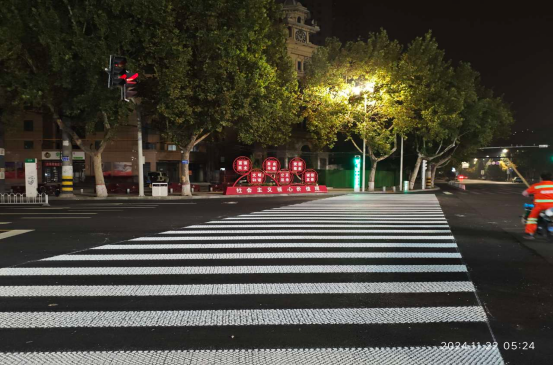
Although the glass beads used in road marking construction are very small, they play an important role in nighttime road visibility. When vehicle headlights shine on the glass beads on the surface of the markings, the light enters the beads and undergoes corresponding optical processes, causing some of the light to return towards the light source, making the road markings easier for drivers to see.
Therefore, glass beads are sometimes used in conjunction with the application of paint for road markings . However, the nighttime effect of road markings cannot be simply understood as "the more glass beads sprinkled, the brighter it will be," because the bonding between the glass beads and the marking material, the spreading method, and the final state on the marking surface all affect the actual performance.
Road markings are ultimately a complete application system. The materials need to form the corresponding marking structure, and the glass beads need to fit properly with the marking surface. If the construction conditions change significantly, even using the same materials and glass beads, the final effect may differ.
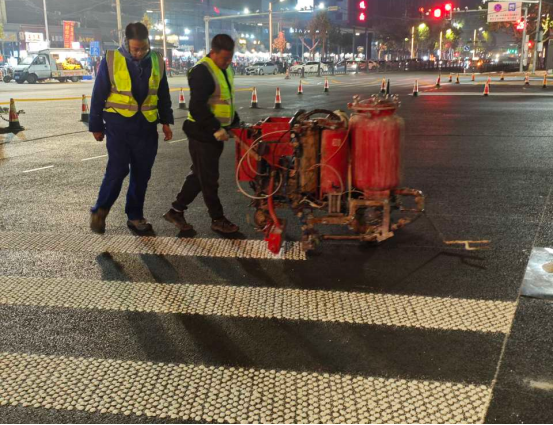
Taking hot-melt road marking paint as an example, after the material is heated and applied to the road surface, the application of glass beads needs to be coordinated with the marking process. Factors such as material condition, application time, and construction equipment all affect the final marking surface. Therefore, when evaluating the nighttime performance of road markings, it is necessary to observe the material, glass beads, and construction process together.
After road markings are installed, they begin to face long-term vehicle traffic and the natural environment. Vehicle tires constantly pass over the marking surface, and rainwater, dust, and road pollutants may gradually affect the surface condition of the markings. Therefore, the condition of the markings after a period of use will not be exactly the same as when they were first installed.
The usage varies depending on the location of the road. Locations where vehicles frequently change lanes, brake, or turn may experience more complex effects. Therefore, when observing the condition of road markings, it is worthwhile to combine daytime appearance and nighttime visibility to make a judgment, rather than just looking at whether the color is still white.
Road marking materials ultimately serve more than simply "drawing a line on the road." They help drivers obtain road information through different line types, colors, and corresponding nighttime visibility effects. Therefore, material selection and construction must be based on the specific requirements of the project for the road markings.
Tatu Highway Coatings offers various material systems for road markings, including hot-melt, two-component, water-based, and room-temperature types. For practical engineering projects, a proper coordination between materials, glass beads, construction equipment, and on-site processes is essential for road markings to better fulfill their function of conveying road information.
Related Reading
Why Do Road Markings Peel Off? Common Factors from Pavement Condition to Material Application
2026-09-01
Why Does Thermoplastic Road Marking Require Heating? Understanding the Application Logic of Thermoplastic Markings Through Material Conditions
2026-08-26
Don’t Be Fooled by Cheap Road Marking Coatings: Beware of Hidden Maintenance Costs
2026-08-06